


 Tiếng Việt
 Русский
Are you wondering whether you can undergo orthodontic treatment after getting dental implants, and how to properly sequence both procedures? This clinical guide from True Dental explains the biomechanics, pros and cons, optimal treatment sequence, and essential aftercare guidelines to achieve safe, predictable orthodontic results alongside dental implants.
Can You Get Braces or Aligners If You Have Dental Implants?
Once a dental implant osseointegrates with the alveolar bone, the Titanium fixture becomes rigidly ankylosed and cannot move through bone like a natural tooth supported by a periodontal ligament (PDL). Nevertheless, combining dental implants and orthodontics is entirely feasible in many clinical scenarios. When a patient has one or a few single implants, an orthodontist can even utilize the stable fixture as absolute orthodontic anchorage to guide surrounding natural teeth using fixed brackets or clear aligners.

Conversely, if you have already received full-arch implant restorations (such as All-on-4 or All-on-6), orthodontic tooth movement is impossible because the entire prosthesis is rigidly anchored—and unnecessary, as full-arch rehabilitation already establishes ideal arch alignment and smile aesthetics.
Can Dental Implants and Orthodontic Treatment Be Performed Simultaneously?
Performing implant placement and orthodontic movement at the exact same time is generally not recommended due to opposing biomechanical principles: implants require absolute immobility for osseointegration, whereas orthodontics relies on controlled tooth movement through bone remodeling.

However, when a patient has one or several fully osseointegrated single implants, an experienced orthodontist can strategically leverage those fixtures as rigid anchorage points to align adjacent natural teeth with braces or clear aligners using modern 3D digital planning.
In short, implantology and orthodontics can be successfully integrated, provided they follow a carefully staged, interdisciplinary treatment sequence rather than uncoordinated simultaneous procedures.
Should You Get Braces First or Dental Implants First?
In the vast majority of cases, specialists recommend completing orthodontic treatment prior to dental implant placement. Aligning the natural dentition first establishes ideal occlusal relationships, opens or consolidates exact mesiodistal and vertical prosthetic space, and ensures optimal long-term aesthetic harmony around the future implant crown.

In select cases where a missing posterior tooth is needed as an anchor to move adjacent teeth—or where immediate replacement is clinically indicated—the specialist may place the implant first and subsequently use it as stationary anchorage during orthodontic therapy. Because an osseointegrated implant remains permanently fixed, interdisciplinary planning between the orthodontist and implantologist is critical.
5-Step Protocol for Orthodontic Treatment After Dental Implants
Undergoing orthodontics with existing dental implants requires a precision-controlled clinical workflow to move natural teeth safely without placing destructive lateral forces on the implant fixture:
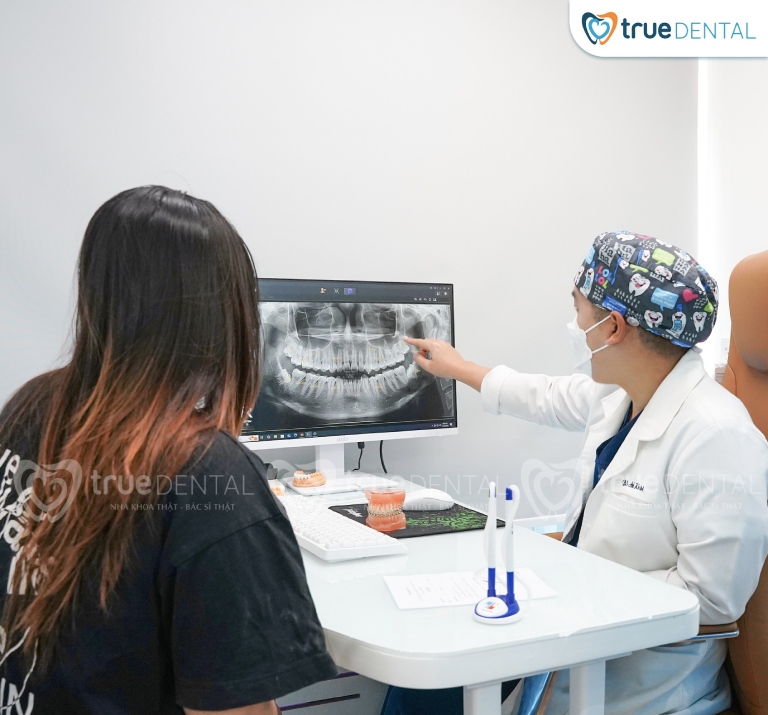
Step 1 — Comprehensive Oral Examination & 3D Radiographic Imaging
The specialist evaluates periodontal health, occlusion, and existing implant sites using panoramic radiographs and 3D Cone Beam CT (CBCT) scans to confirm complete osseointegration and map planned tooth movements.
Step 2 — Interdisciplinary Digital Treatment Planning
Using digital intraoral scans and 3D diagnostics, the orthodontist designs a customized biomechanics plan that aligns natural teeth into ideal occlusion while keeping the fixed implant fixture completely free of unwanted orthodontic forces.
Step 3 — Orthodontic Appliance Placement
Depending on clinical needs, the clinician bonds metal or ceramic brackets or delivers custom clear aligners engineered to apply controlled forces exclusively to natural teeth—or utilizes the implant crown as a stationary anchor.
Step 4 — Regular Orthodontic Adjustments & Implant Monitoring
Scheduled follow-up appointments allow the orthodontist to calibrate archwire activations or aligner progression while verifying peri-implant stability and gingival health.
Step 5 — Appliance Removal & Retainer Wear
Once ideal alignment and occlusion are achieved, brackets or aligners are removed, and a custom retainer is prescribed for 6 to 12+ months to prevent orthodontic relapse while the implant remains securely in its original position.
Key Precautions When Undergoing Orthodontics After Implant Placement
Because osseointegrated implants lack a shock-absorbing periodontal ligament, patients undergoing orthodontic treatment after implant placement should observe these essential precautions:
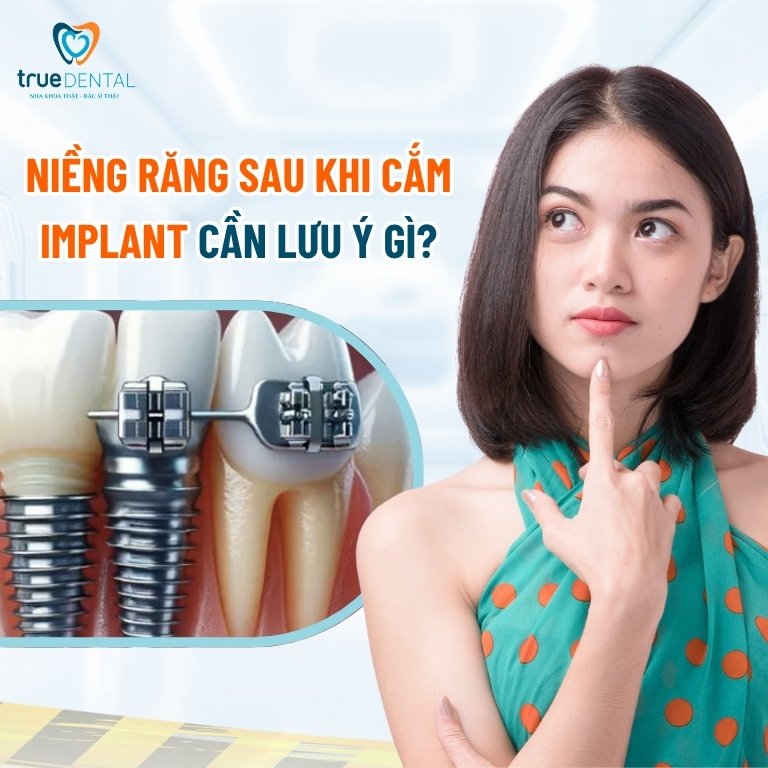
- Choose an Accredited Interdisciplinary Dental Center: Ensure your care is coordinated by experienced orthodontists and implantologists utilizing 3D digital planning.
- Avoid Excessive Bite Force on the Implant Crown: Refrain from biting hard foods or objects to protect both orthodontic brackets and the implant restoration.
- Favor Soft Foods During Initial Adjustments: Choose gentle, easy-to-chew foods after appliance placement or wire activations to minimize occlusal soreness.
- Limit Acidic, Carbonated, and Extreme-Temperature Foods: Protect tooth enamel around brackets and prevent thermal sensitivity.
- Adhere Strictly to Scheduled Follow-Ups: Regular monitoring ensures controlled tooth movement and safeguards peri-implant bone stability.
- Eliminate Parafunctional Oral Habits: Avoid tongue thrusting, nail-biting, or chewing on pens, which can introduce harmful lateral forces.
- Contact Your Clinician If Pain Persists Beyond 2 Weeks: Prolonged localized discomfort around an implant warrants prompt clinical evaluation.
Post-Orthodontic Care Guidelines for Dental Implants
Once active orthodontic treatment concludes and natural teeth settle into their new positions alongside your fixed implant, consistent home care preserves both results long-term:
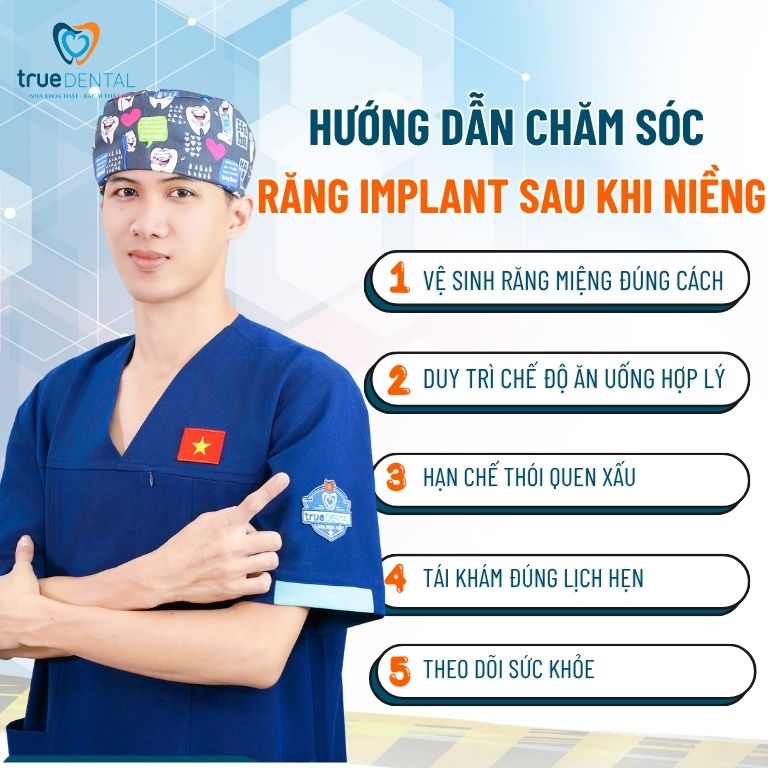
Maintain a Gentle, Balanced Diet
Continue eating soft, nutrient-rich foods for the first 1 to 2 weeks following appliance removal while periodontal fibers stabilize, cutting firm foods into bite-sized pieces rather than incising directly with anterior restorations.
Practice Thorough Daily Oral Hygiene
- Brush gently twice daily with an extra-soft toothbrush, paying close attention to the gingival margin around the implant crown and newly aligned teeth.
- Clean interproximally with implant-safe floss, interdental brushes, or a water flosser to disrupt biofilm without traumatizing peri-implant mucosa.
- Rinse daily with warm saline or an alcohol-free antimicrobial mouthwash after meals to maintain optimal oral hygiene.
Avoid Harmful Habits & Lifestyle Risk Factors
- Never use your teeth to open packaging, crack nuts, or bite hard objects, as sudden shear forces can chip porcelain crowns or damage natural enamel.
- Avoid tobacco smoking and limit alcohol and sugary carbonated beverages to protect peri-implant tissue health and prevent mucosal inflammation.
Wear Your Retainer & Attend Maintenance Visits
Wear your orthodontic retainer strictly as prescribed (typically 20+ hours daily initially) to prevent tooth shifting, and attend routine dental checkups so your specialist can verify occlusion, retainer fit, and peri-implant bone levels.
Monitor Peri-Implant & Oral Health
Stay well-hydrated to support healthy salivary flow, and contact your dentist promptly if you notice persistent pain, gingival bleeding, swelling, or any sensation of crown mobility.
READ MORE:
Because dental implants remain permanently anchored in bone while orthodontics relies on controlled tooth movement, both treatments must follow a carefully sequenced interdisciplinary plan—most commonly completing orthodontics first and placing implants afterward, or strategically using an existing implant as stationary orthodontic anchorage.
If you are considering combining orthodontics and dental implants, visit True Dental today for a complimentary 3D examination and personalized interdisciplinary consultation with our specialists!

Sức Khỏe Răng Miệng
How long does it take to complete the process of getting dental implants?
Tooth replacement affects far more than just smile...
Sức Khỏe Răng Miệng
How much does it cost to replace a molar? Which method is most effective?
First and second molars—commonly referred to in Vietnamese...
Sức Khỏe Răng Miệng
How much does it cost to replace a single tooth? 2026 Price List
Tooth replacement is an effective restorative solution for...
Sức Khỏe Răng Miệng
Which country are Nobel dental implants from? How much do they cost?
Nobel Biocare dental implants stand out for rapid...
Sức Khỏe Răng Miệng
Straumann Dental Implants: Features, Origin, and Cost
Straumann dental implants are widely chosen by patients...
Sức Khỏe Răng Miệng
What are dental implants? When are dental implants needed?
Tooth loss affects far more than just smile...
Tôi đang tìm 1 Nha Khoa để điều trị cho tôi, nhưng rất lo lắng và sợ gặp phải NHA TẶC hoặc bị chèo kéo.
HÃY GIÚP TÔI TƯ VẤN THẬT
254 Điện Biên Phủ, Xuân Hòa, TP.HCM
HƯỚNG DẪN ĐƯỜNG ĐI