

 Tiếng Việt
 Русский
Losing an incisor causes significant difficulty in chewing and often makes many people feel self-conscious when communicating. Many patients wonder whether incisor implant placement is possible and what precautions should be kept in mind. You will find the answers right in this article.
How Does Incisor Loss Affect Your Health?
Losing an anterior tooth exerts numerous negative impacts on your health, compromising aesthetics, masticatory function, and speech articulation. Among these, the most noticeable consequence is aesthetic: because incisors occupy the central position on the dental arch, their loss creates facial asymmetry, leading to a lack of confidence when speaking and smiling.
Additionally, missing front teeth diminishes chewing efficiency. Food is not processed thoroughly before entering the stomach, forcing the digestive tract to work harder, which over time can lead to gastrointestinal disorders and various systemic health concerns.

Furthermore, when a missing front tooth is not restored promptly, the alveolar bone at the edentulous site undergoes progressive resorption. This not only accelerates facial aging, making you appear older, but can also alter jaw structures and cause sunken cheeks.
READ MORE: [EXPLAINED] CAN PATIENTS WITH PERIODONTITIS RECEIVE DENTAL IMPLANTS?
Can Dental Implants Be Placed for Front Teeth? How Does the Process Work?
In fact, dental implant placement for an incisor is the optimal restorative solution that patients should consider. A dental implant not only restores full chewing function but also ensures facial aesthetics thanks to a shape, size, and shade indistinguishable from natural teeth.
A dental implant can last over 20 years or even a lifetime with proper care. Moreover, placing an implant fixture preserves the jawbone and halts progressive bone loss.
Furthermore, dental implant placement avoids grinding down or compromising adjacent healthy teeth, unlike traditional porcelain dental bridges. The implant procedure ensures long-term durability and safety when carried out by highly experienced specialists supported by state-of-the-art diagnostic imaging, such as dental X-rays and Cone Beam CT scans.

Additionally, performing implant placement using GST technology with an AI-guided surgical stent to position the implant fixture ensures minimal invasiveness, dramatically reducing post-operative pain and bleeding. Therefore, if you are wondering whether dental implants can replace missing front teeth, the answer is definitively yes.
The 7-step GST-guided dental implant procedure for incisors includes:
Prior to recommending implant surgery, the doctor must evaluate the patient’s blood test results. This helps identify any underlying systemic conditions and allows the clinician to formulate an appropriate, safe treatment pathway.
Furthermore, blood work screens for bloodborne infectious diseases such as Hepatitis B, HIV/AIDS, etc. If present, elective surgery may be contraindicated due to high transmission and cross-contamination risks.
Taking dental X-rays and Cone Beam CT scans allows the clinician to precisely assess the patient’s oral anatomy, determining the exact bone volume and optimal coordinates for implant insertion.
Additionally, Cone Beam CT imaging detects alveolar bone resorption early, enabling the doctor to plan adjunctive procedures such as bone grafting or sinus augmentation when needed. This ensures both safety and high restorative precision for the patient.
Capturing digital intraoral impressions and scanning 3D data via specialized software is an essential step prior to fabricating the AI surgical guide. This step ensures that the surgical template fits snugly against the dental arch while leaving precise openings over the intended surgical site.
The AI surgical guide is milled in the dental laboratory according to the patient’s individualized 3D anatomical data. This stent guides the clinician in accurately identifying the 3D angulation and depth for the missing incisor.
The AI surgical guide comprises three components: the guide base, drill sleeves, and retention pins/screws. With this custom appliance, implant placement is safe, minimally invasive, and often flapless without extensive gum incision.
Once the AI surgical guide is completed, the doctor tries it on the patient’s dental arch to confirm complete passive seating. Once fit criteria are verified, implant placement proceeds smoothly through the guided sleeves.
Following successful fixture placement, the doctor may deliver an immediate provisional crown depending on primary stability and individual clinical factors. The patient then follows post-op hygiene guidelines while awaiting complete osseointegration with the jawbone.
Once the implant fixture has fully integrated with the jawbone, the clinician fabricates and cements or screws the permanent porcelain crown onto the abutment. After the final crown is secured, the patient can chew comfortably just like with natural teeth.
How Much Does an Incisor Dental Implant Cost?
The cost of placing an incisor implant varies depending on the number of missing teeth and the patient’s overall oral condition. For example, cases involving long-standing tooth loss with significant bone resorption requiring bone grafting prior to fixture placement will incur higher overall costs.
Furthermore, costs depend on the specific implant brand chosen by the patient. Several high-quality implant lines well-suited for front-tooth restorations are available within the following price ranges:
| Implant Fixture | Price |
| Straumann | 36,000,000 – 42,000,000 VND / Fixture |
| Nobel Biocare | 36,000,000 – 42,000,000 VND / Fixture |
| Swiss | 24,500,000 – 32,000,000 VND / Fixture |
| Hiossen | 22,000,000 – 24,800,000 VND / Fixture |
| Osstem | 22,000,000 – 24,800,000 VND / Fixture |
| Biotem | 9,900,000 – 19,800,000 VND / Fixture |
Important Considerations When Placing Incisor Implants
When undergoing dental implant placement for front teeth, several crucial considerations must be observed:
- Assess bone and soft tissue condition: The anterior zone features thin cortical plates that resorb rapidly post-extraction. Therefore, the clinician must carefully evaluate residual bone volume and quality to ensure proper stability. If bone support is inadequate, prior or concurrent bone grafting may be required.
- Select the appropriate implant system: Implant fixtures must be chosen carefully to match the delicate anatomy of the anterior region. Narrow-diameter fixtures engineered specifically for the aesthetic zone provide superior soft-tissue adaptation and functional outcomes.
- Choose the right shade and contour for the crown: Because front teeth are prominently visible, the final restoration must closely match adjacent natural dentition in shade, translucency, contour, and proportion.
- Adhere to post-surgical care: Following fixture placement, patients must maintain a soft diet and meticulous oral hygiene. Avoid heavy bite forces on the surgical area and follow all clinical instructions to ensure uninterrupted osseointegration.
- Attend scheduled follow-up visits: Regular follow-up appointments during the osseointegration period are mandatory. These visits allow the clinician to track tissue healing, assess bone remodeling, and manage any unexpected developments promptly.
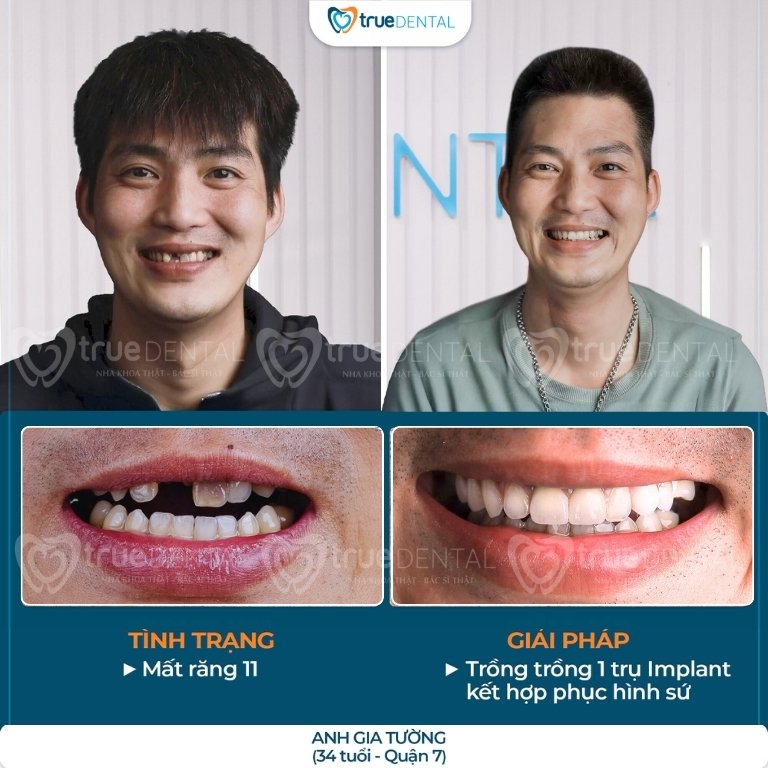
In addition, choosing a reputable dental clinic staffed by experienced implant specialists is essential to ensuring safety and achieving optimal aesthetic and functional results. If you are experiencing incisor loss or any missing teeth along the arch, please contact True Dental via hotline 090 6636 456 for dedicated support.

Sức Khỏe Răng Miệng
How long does it take to complete the process of getting dental implants?
Tooth replacement affects far more than just smile...
Sức Khỏe Răng Miệng
How much does it cost to replace a molar? Which method is most effective?
First and second molars—commonly referred to in Vietnamese...
Sức Khỏe Răng Miệng
How much does it cost to replace a single tooth? 2026 Price List
Tooth replacement is an effective restorative solution for...
Sức Khỏe Răng Miệng
Which country are Nobel dental implants from? How much do they cost?
Nobel Biocare dental implants stand out for rapid...
Sức Khỏe Răng Miệng
Straumann Dental Implants: Features, Origin, and Cost
Straumann dental implants are widely chosen by patients...
Sức Khỏe Răng Miệng
What are dental implants? When are dental implants needed?
Tooth loss affects far more than just smile...
Tôi đang tìm 1 Nha Khoa để điều trị cho tôi, nhưng rất lo lắng và sợ gặp phải NHA TẶC hoặc bị chèo kéo.
HÃY GIÚP TÔI TƯ VẤN THẬT
254 Điện Biên Phủ, Xuân Hòa, TP.HCM
HƯỚNG DẪN ĐƯỜNG ĐI