


 Tiếng Việt
 Русский
Renowned for its exceptional biocompatibility and superior mechanical strength, Titanium is widely utilized across biomedical and restorative disciplines, particularly in modern implant dentistry. Join True Dental as we explore the metallurgical properties of Titanium and why it remains the gold-standard biomaterial for endosseous dental implants.
What Is Titanium?
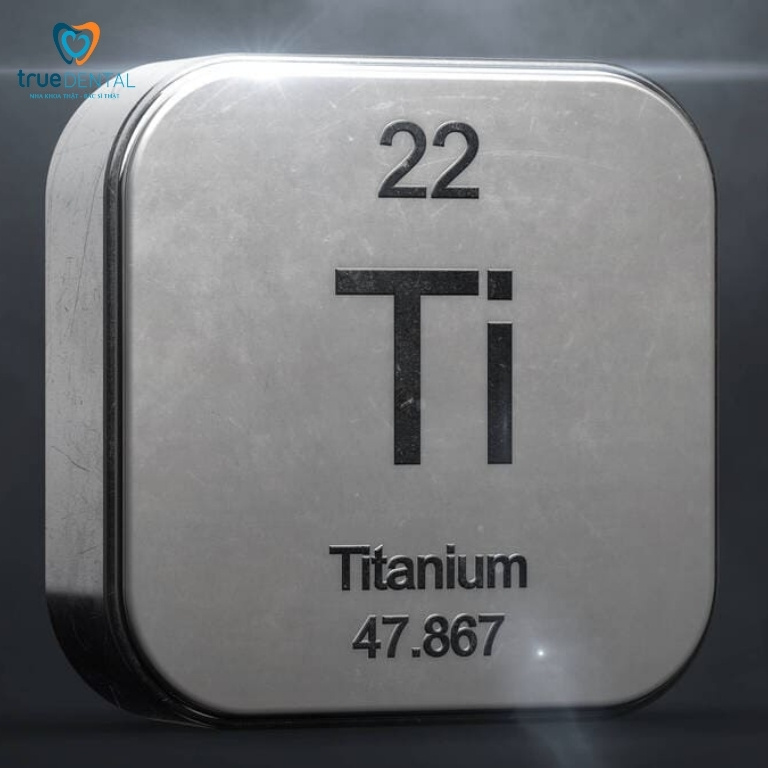
Titanium (chemical symbol: Ti), discovered in 1791, is a lightweight, high-strength, corrosion-resistant transition metal. Abundant in the Earth’s crust primarily in oxide form, Titanium is distinguished by its remarkable strength-to-weight ratio—weighing approximately 40% less than steel while delivering comparable or superior tensile strength.
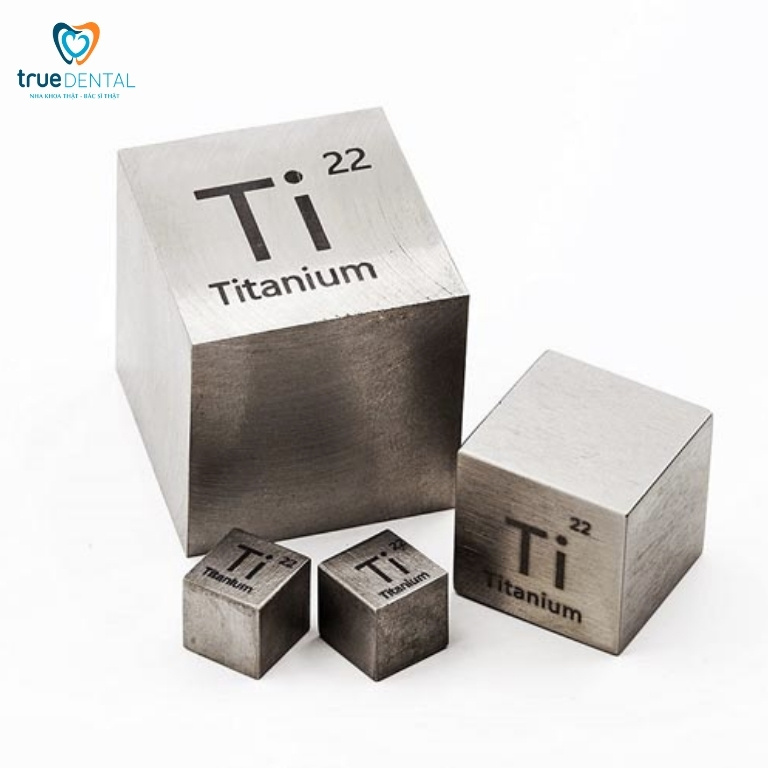
In biomedical engineering and implantology, commercially pure Titanium and medical-grade Titanium alloys represent the primary biomaterials for fabricating endosseous implant fixtures due to their bioinert nature, eliminating foreign-body rejection or allergic reactions. The integration of Titanium into restorative dentistry has revolutionized tooth replacement, restoring natural masticatory efficiency and smile aesthetics.
READ MORE: ABUTMENT: ANATOMY, CHARACTERISTICS, AND CLINICAL ROLE IN DENTAL IMPLANTOLOGY
Key Properties of Medical-Grade Titanium
Titanium exhibits several distinct physicochemical and biological properties that make it the ideal biomaterial for endosseous dental implants:
- Lightweight Density: Titanium is significantly lighter than surgical stainless steel without compromising mechanical rigidity. This reduces biomechanical stress on the supporting alveolar bone following fixture insertion, enhancing patient comfort and natural proprioception.
- Superior Corrosion Resistance: Titanium spontaneously forms a stable, self-passivating titanium dioxide ($TiO_2$) surface layer that resists electrochemical corrosion even in acidic or saline environments. Within the oral cavity, a Titanium implant fixture remains completely unaffected by saliva, pH fluctuations, or dietary acids, ensuring long-term structural integrity.
- Exceptional Biocompatibility: When surgically anchored into the jawbone, Titanium elicits no cytotoxic or inflammatory tissue response. Instead, its oxide layer promotes direct osteoblast adhesion and biological osseointegration, establishing a rigid structural bond between living bone and the implant surface.
- High Fatigue and Fracture Strength: Titanium withstands heavy, repetitive axial and lateral occlusal forces generated during daily mastication without plastic deformation or fracture, guaranteeing predictable clinical longevity.
The Role of Titanium Fixtures in Dental Implantology
In implant dentistry, Titanium serves as the foundational biomaterial for the endosseous implant fixture—the artificial tooth root surgically placed into the alveolar ridge. Once complete osseointegration is achieved, the Titanium fixture provides a rigid anchor for supporting a custom ceramic crown, bridge, or full-arch prosthesis.
Titanium enables the restoration to bear physiological chewing loads equivalent to natural dentition. Unlike conventional fixed dental bridges—which require irreversible preparation of healthy neighboring teeth—or unstable removable dentures, Titanium implant therapy replaces missing teeth independently while preserving adjacent natural tooth structure.
Furthermore, Titanium fixtures preserve facial architecture by transmitting functional occlusal forces into the jawbone, preventing progressive alveolar ridge resorption and maintaining youthful lower facial contours.
Beyond functional rehabilitation, Titanium implants provide seamless comfort during speech and mastication, cementing Titanium’s status as the premier material for modern dental implant restoration.
Clinical Advantages of Titanium Dental Implants
Dental implant placement utilizing Titanium fixtures offers a comprehensive, long-term solution for edentulism while preventing secondary oral complications. Key clinical advantages include:
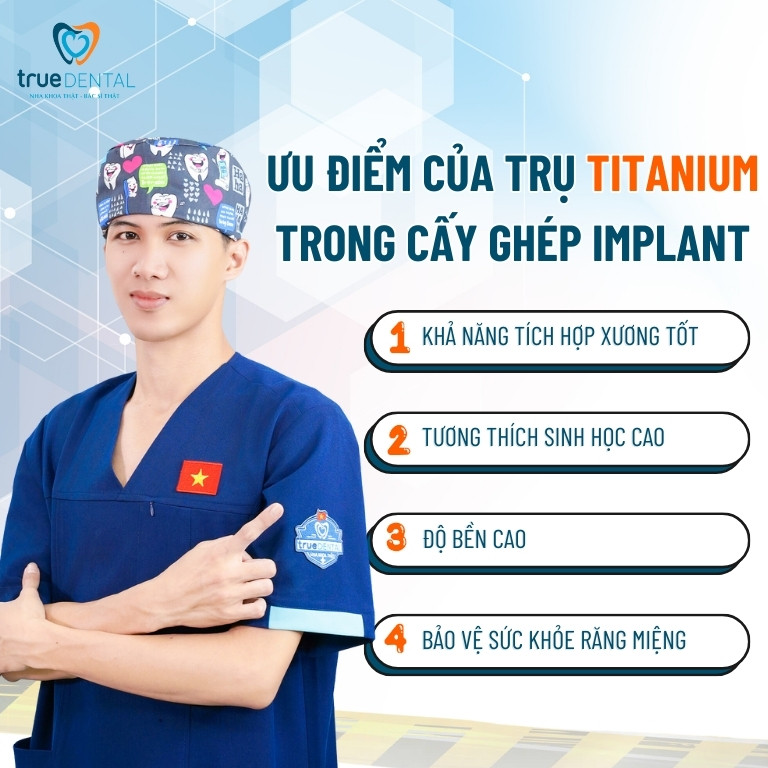
- Predictable Osseointegration: Micro-textured Titanium surfaces stimulate osteogenesis and direct bone-to-implant contact (BIC), securing rigid, long-term fixture stability.
- High Biocompatibility: Bioinert and non-allergenic, medical-grade Titanium integrates safely with human hard and soft tissues without adverse immune reactions.
- Exceptional Durability: Resistant to occlusal fatigue and corrosion, Titanium implants boast a lifespan spanning decades—and frequently a lifetime—with proper oral hygiene.
- Preservation of Oral Structures: By halting post-extraction bone loss, Titanium implants protect adjacent tooth alignment and maintain healthy peri-implant gingival contours.
Titanium Dental Implant Placement Workflow
Modern implant workflows vary depending on whether conventional freehand surgery or computer-guided digital protocols are utilized. At True Dental, Titanium implant placement integrates GST (Guided Surgery Technology) Biological Implantology with AI surgical templates through the following standardized clinical steps:
- Clinical Examination and 3D Imaging: The specialist performs a comprehensive oral evaluation alongside panoramic X-rays and 3D Cone Beam CT (CBCT) scans to assess bone volume, density, and anatomical landmarks.
- Personalized Treatment Planning: Based on diagnostic data, the clinician formulates an individualized treatment plan specifying optimal fixture dimensions, 3D placement coordinates, and projected healing timelines.
- AI Surgical Guide Design: Utilizing specialized AI planning software, a virtual surgical guide is designed from the patient’s CBCT and intraoral scan data to dictate exact fixture position, depth, and angulation.
- 3D Guide Fabrication and Guided Placement: The surgical template is precision 3D-printed. During surgery, the specialist seats the guide to insert the Titanium fixture accurately via a minimally invasive, flapless approach—minimizing surgical trauma and post-operative discomfort.
- Osseointegration Healing Period: Following placement, the fixture undergoes biological osseointegration over 3 to 6 months. A custom provisional restoration may be delivered during this interval to maintain smile aesthetics and phonetics.
- Definitive Porcelain Crown Delivery: Once complete osseointegration is confirmed, the clinician attaches the precision Abutment and secures the custom porcelain crown, completing the rehabilitation with natural aesthetics and full chewing function.

Titanium has proven irreplaceable in modern implant dentistry thanks to its unique combination of low weight, high mechanical strength, and seamless osseointegration. If you are seeking a safe, predictable tooth replacement solution, contact True Dental today via hotline 090 6636 456 to schedule your complimentary examination and specialist consultation.

Sức Khỏe Răng Miệng
How long does it take to complete the process of getting dental implants?
Tooth replacement affects far more than just smile...
Sức Khỏe Răng Miệng
How much does it cost to replace a molar? Which method is most effective?
First and second molars—commonly referred to in Vietnamese...
Sức Khỏe Răng Miệng
How much does it cost to replace a single tooth? 2026 Price List
Tooth replacement is an effective restorative solution for...
Sức Khỏe Răng Miệng
Which country are Nobel dental implants from? How much do they cost?
Nobel Biocare dental implants stand out for rapid...
Sức Khỏe Răng Miệng
Straumann Dental Implants: Features, Origin, and Cost
Straumann dental implants are widely chosen by patients...
Sức Khỏe Răng Miệng
What are dental implants? When are dental implants needed?
Tooth loss affects far more than just smile...
Tôi đang tìm 1 Nha Khoa để điều trị cho tôi, nhưng rất lo lắng và sợ gặp phải NHA TẶC hoặc bị chèo kéo.
HÃY GIÚP TÔI TƯ VẤN THẬT
254 Điện Biên Phủ, Xuân Hòa, TP.HCM
HƯỚNG DẪN ĐƯỜNG ĐI