


 Tiếng Việt
 Русский
Selecting the appropriate dental implant fixture dimensions is not only a critical factor governing surgical success, but also ensures long-term soft tissue aesthetics and optimal masticatory function. So, how do clinicians determine the ideal implant fixture diameter and length for placement? Let True Dental guide you through the clinical details in this comprehensive article.
Overview of Dental Implant Fixtures
A dental implant fixture is a specialized endosseous biomaterial utilized in dental implant surgery. Typically fabricated from medical-grade Titanium, the fixture is surgically inserted into the jawbone to serve as an artificial tooth root.
Following surgical placement, the implant fixture progressively undergoes osseointegration with the surrounding host bone, establishing a stable foundation to support prosthetic crowns, fixed dental bridges, or implant-retained overdentures. Dental implant therapy also arrests progressive alveolar bone resorption in edentulous patients. Complete osseointegration generally requires 3 to 6 months.
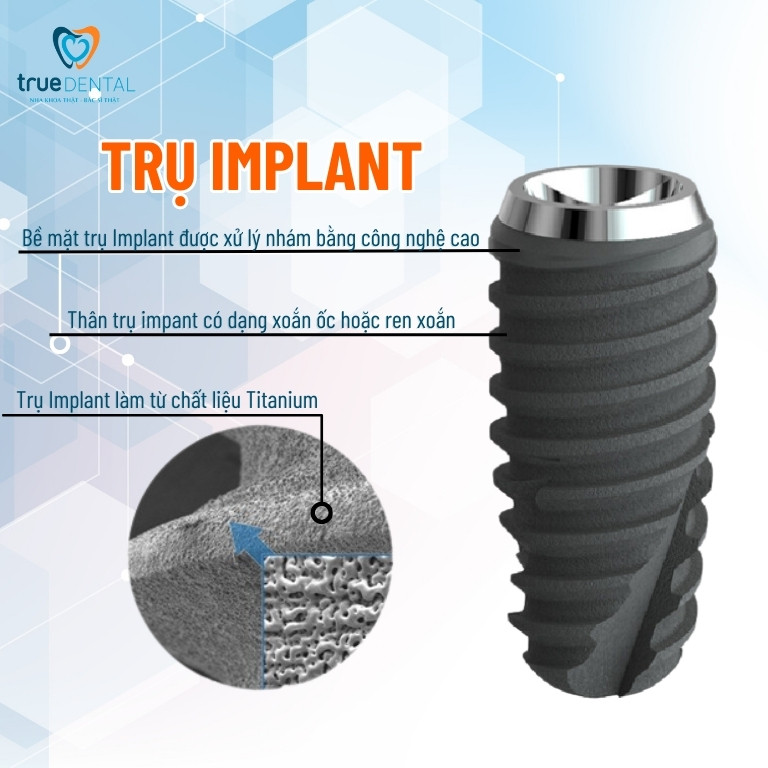
The fixture surface undergoes advanced micro-texturing to achieve controlled surface roughness, accelerating osteoblast attachment, expediting soft and hard tissue healing, and maximizing secondary stability. The fixture body features helical thread geometry to expand bone-to-implant contact (BIC) surface area, while the cervical collar serves as the transitional platform connecting directly to the Abutment to support the overlying porcelain restoration.
Why Are Dental Implant Fixture Dimensions Important?
Many patients assume that selecting an implant system depends solely on alloy composition and surface treatment technology. However, fixture dimensions represent an equally crucial clinical parameter.
Fixture dimensions directly govern primary mechanical stability and osseointegration potential. Inserting an oversized or undersized fixture relative to the host bone ridge can cause mechanical instability, increasing the risks of fibrous encapsulation, fixture failure, or surgical complications.

Consequently, dimensional selection is paramount. Based on residual alveolar bone volume, anatomical site, and the number of missing teeth, the specialist prescribes the optimal fixture dimensions. For instance, narrow-diameter fixtures are generally indicated for single-unit restorations in narrow interdental spaces.
Appropriately sized implant fixtures ensure the definitive porcelain crown withstands physiological occlusal loads equivalent to natural dentition without mobility or mechanical fracture. Accurate dimensional planning also minimizes post-operative complications such as crestal bone loss, soft tissue trauma, or peri-implantitis.
READ MORE: COMPARISON OF POPULAR DENTAL IMPLANT FIXTURES TODAY: WHICH SYSTEM IS BEST?
Standard Dimensions of Dental Implant Fixtures Today
Modern implant systems are manufactured in a wide range of dimensions to accommodate diverse anatomical presentations. The two primary dimensional parameters are diameter and length. While specifications vary slightly across manufacturers, standard dental implant dimensions generally fall within the following classifications:
Classification of Implant Fixtures by Diameter
Implant fixture diameter is measured across the widest coronal thread or platform. Standard fixture diameters range from 3.0 mm to 6.0 mm. Additionally, mini dental implants with ultra-narrow diameters are available for specific clinical indications involving severely resorbed ridges or restricted interdental spaces:
| Implant Fixture Category | Diameter (mm) |
| Mini Implant Fixture | 2.4 – 2.9 |
| Extra-Narrow Implant Fixture | 3.0 – 3.3 |
| Narrow-Diameter Implant Fixture | 3.5 – 4.0 |
| Standard-Diameter Implant Fixture | 4.1 – 4.8 |
| Wide-Diameter Implant Fixture | 5.0 – 6.0 |
Classification of Implant Fixtures by Length
Implant fixture length is measured from the coronal platform to the apical tip, typically ranging from 8.0 mm to 16.0 mm. Beyond standard lengths, specialized short and extra-long fixtures (such as zygomatic or pterygoid implants) are engineered to address severe vertical bone deficiencies or avoid invasive grafting procedures:
| Implant Fixture Category | Length (mm) |
| Extra-Short Implant Fixture | 4.0 – 7.0 |
| Short Implant Fixture | 7.0 – 10.0 |
| Standard-Length Implant Fixture | 11.5 – 13.0 |
| Long Implant Fixture | 15.0 – 18.0 |
How to Select the Appropriate Implant Fixture Dimensions
According to implant specialists at True Dental, ideal implant dimensions typically fall within a diameter of 3.0 mm – 6.0 mm and a length of 8.0 mm – 12.0 mm. For mandibular sites, fixture lengths commonly range from 8.0 mm – 10.0 mm, whereas maxillary sites often utilize slightly longer fixtures of 10.0 mm – 12.0 mm to compensate for lower trabecular bone density and ensure long-term biomechanical stability. Additionally, dimensional selection depends on several clinical factors:
- Bone-to-Implant Dimensional Ratio: Dense, voluminous host bone accommodates wider and longer fixtures. Conversely, compromised bone width or height necessitates narrow-diameter or short fixtures unless bone augmentation is performed.
- Anatomical Landmarks: Due to distinct neurovascular structures and sinus anatomy between the arches, clinicians tailor dimensions for the maxilla and mandible independently. Wider fixtures are often favored in the maxilla to maximize surface contact, while carefully measured lengths are selected in the mandible to maintain a safe margin above the inferior alveolar nerve canal.
- Number of Missing Teeth and Prosthetic Span: The number and distribution of edentulous sites dictate fixture load requirements. Full-arch implant rehabilitations typically utilize wider, longer fixtures to distribute heavy occlusal forces across the prosthesis, whereas single-tooth restorations can effectively utilize standard or narrow fixtures depending on occlusal load.

Selecting the proper implant dimensions cannot be based on guesswork; it requires precise diagnostic evaluation of residual bone morphology and edentulous span. Therefore, patients should visit an accredited dental center for thorough diagnostic imaging, including panoramic X-rays and Cone Beam CT (CBCT) scans.
We hope this overview helps clarify the significance of dental implant dimensions and how clinicians determine the optimal diameter and length for placement. If you have any further questions, contact True Dental today via hotline 090 6636 456 to schedule your examination and consultation with an accredited specialist.

Sức Khỏe Răng Miệng
How long does it take to complete the process of getting dental implants?
Tooth replacement affects far more than just smile...
Sức Khỏe Răng Miệng
How much does it cost to replace a molar? Which method is most effective?
First and second molars—commonly referred to in Vietnamese...
Sức Khỏe Răng Miệng
How much does it cost to replace a single tooth? 2026 Price List
Tooth replacement is an effective restorative solution for...
Sức Khỏe Răng Miệng
Which country are Nobel dental implants from? How much do they cost?
Nobel Biocare dental implants stand out for rapid...
Sức Khỏe Răng Miệng
Straumann Dental Implants: Features, Origin, and Cost
Straumann dental implants are widely chosen by patients...
Sức Khỏe Răng Miệng
What are dental implants? When are dental implants needed?
Tooth loss affects far more than just smile...
Tôi đang tìm 1 Nha Khoa để điều trị cho tôi, nhưng rất lo lắng và sợ gặp phải NHA TẶC hoặc bị chèo kéo.
HÃY GIÚP TÔI TƯ VẤN THẬT
254 Điện Biên Phủ, Xuân Hòa, TP.HCM
HƯỚNG DẪN ĐƯỜNG ĐI