


 Tiếng Việt
 Русский
Many patients who have already restored missing teeth with dental implants later consider orthodontic treatment to enhance their smile and facial harmony. This raises an important clinical question: Can you get braces or clear aligners after receiving dental implants? And more importantly, should orthodontic treatment or dental implant placement come first? Let’s explore the clinical guidelines with True Dental below.
What Are Dental Implants and Orthodontic Braces?
Dental implant placement and orthodontic therapy are two distinct dental specialties aimed at restoring oral health and function, each operating through a fundamentally different biological mechanism:
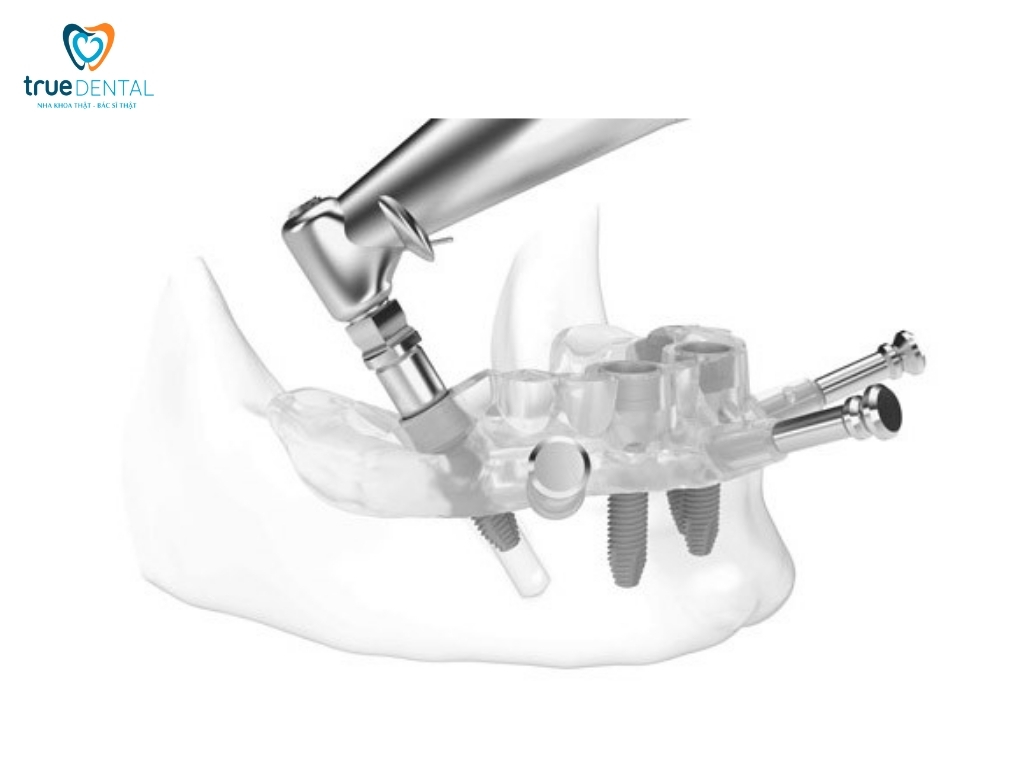
Dental Implant Placement
Dental implant placement is the gold-standard prosthodontic solution for replacing missing teeth. A biocompatible medical-grade titanium fixture is surgically anchored into the jawbone to replace the missing tooth root, integrating permanently with host bone to support a custom porcelain crown that restores natural chewing efficiency and aesthetics.
Orthodontic Treatment (Braces & Clear Aligners)
Orthodontic treatment uses fixed brackets or clear aligners to apply controlled, gentle biomechanical forces that gradually move misaligned natural teeth through the periodontal ligament into ideal arch alignment and balanced occlusion—improving smile aesthetics, masticatory function, and long-term periodontal hygiene.

While both modalities play essential roles in comprehensive oral rehabilitation, their distinct biological properties determine how they interact when combined.
READ MORE: ADVANTAGES AND DISADVANTAGES OF DENTAL IMPLANTS YOU SHOULD KNOW
Can You Get Braces After Getting Dental Implants?
Yes—in select clinical cases, orthodontic treatment can be performed after single-tooth dental implant placement, provided it is thoroughly evaluated and planned by an experienced orthodontist and implantologist. Several critical biomechanical factors govern whether orthodontic tooth movement is feasible around an existing implant:
- Ankylosed Stability of the Implant Fixture: Unlike natural teeth, which are suspended in bone by a flexible periodontal ligament (PDL) that enables orthodontic remodeling, an osseointegrated dental implant is fused directly to alveolar bone and cannot move. Consequently, only the surrounding natural teeth can be shifted, requiring precise 3D digital planning so the implant does not obstruct adjacent tooth movement—or can even serve as an absolute orthodontic anchorage point.
- Occlusal Adjustment Limitations: Because an existing implant crown cannot be repositioned orthodontically, achieving ideal midline and inter-arch occlusion can be more complex if an implant was placed in an unfavorable position prior to braces.
- Skeletal Maturation & Bone Remodeling: In younger patients whose craniofacial structures are still remodeling, an ankylosed implant will not erupt alongside natural teeth. In adults, the specialist must evaluate alveolar bone volume and implant coordinates via 3D CBCT to ensure safe, predictable movement of neighboring teeth.

Importantly, post-implant orthodontics applies only to patients with single-tooth or isolated dental implants. Patients who have undergone full-arch implant rehabilitation (such as All-on-4 or All-on-6) cannot undergo orthodontic tooth movement—nor do they need it, as tooth alignment, arch form, and occlusion have already been comprehensively engineered into their custom full-arch prosthesis.
Should You Get Braces First or Dental Implants First?
To achieve optimal functional and aesthetic harmony, interdisciplinary sequencing between orthodontics and implantology is crucial. True Dental specialists recommend a comprehensive clinical and 3D radiographic evaluation before initiating either treatment.
In the vast majority of cases, completing orthodontic treatment before placing dental implants is the clinical gold standard. Aligning the natural dentition first corrects crowding, establishes ideal inter-arch occlusion, and opens or closes edentulous spaces to exact prosthetic dimensions. Once braces or aligners are completed, the dental implant is placed into its ideal final position without interfering with tooth movement.
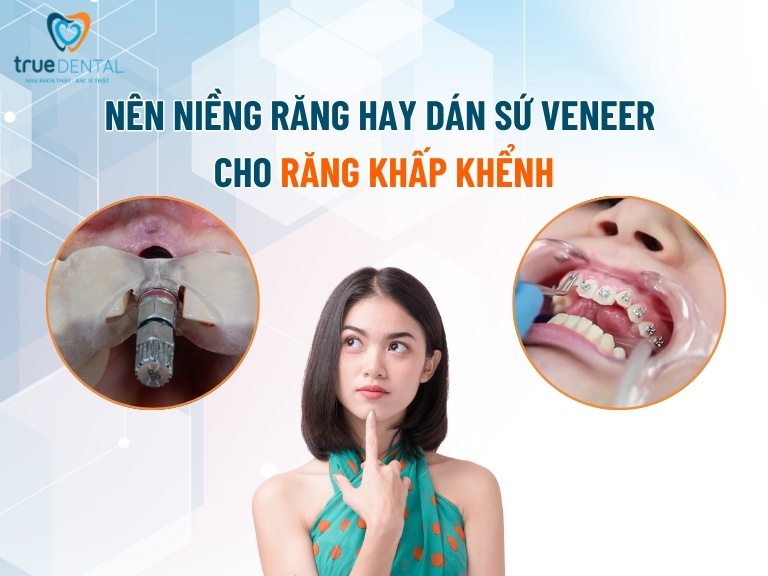
In fact, many orthodontic treatment plans require therapeutic premolar extractions to create space for aligning crowded teeth. If a patient is already missing a tooth in a planned extraction zone, orthodontic space closure may eliminate the need for a dental implant altogether.
Conversely, when a patient already has an existing single-tooth implant and subsequently desires orthodontics, the specialist designs a customized force system that moves the natural teeth smoothly around the stationary implant—or utilizes the implant as stable anchorage—without placing damaging shear forces on the implant restoration.
Ultimately, determining the ideal treatment sequence depends on your occlusal relationships, edentulous site location, and 3D bone diagnostics at an accredited multidisciplinary dental center.
Essential Precautions for Orthodontic Treatment After Dental Implants
If you already have a single-tooth dental implant and wish to undergo orthodontic treatment, follow these four clinical guidelines for safe, predictable results:
- Choose a Multidisciplinary Clinic with Experienced Specialists: Coordinating orthodontics around existing implants requires close collaboration between a board-certified orthodontist and an experienced implantologist with proven expertise in both disciplines.
- Complete 3D CBCT & Periodontal Screening: Before bonding brackets or fabricating clear aligners, verify peri-implant bone health, osseointegration stability, and exact root-to-implant clearances via 3D imaging.
- Follow a Customized Orthodontic Biomechanical Protocol: Adhere strictly to your specialist’s orthodontic treatment plan, which may utilize clear aligners or custom bracket mechanics engineered to avoid excessive torque on the implant crown.
- Maintain Regular Monitoring & Meticulous Oral Hygiene: Attend all scheduled orthodontic adjustments so your clinician can monitor tooth tracking and peri-implant tissue health, while brushing and flossing diligently around both brackets and the implant crown.
In summary, you can undergo orthodontic treatment after receiving a single-tooth dental implant, provided an experienced specialist confirms candidacy and designs an individualized biomechanical plan. To schedule a comprehensive interdisciplinary evaluation and 3D consultation, contact True Dental today via Hotline 090 6636 456.

[Q&A] CAN YOU GET BRACES AFTER HAVING DENTAL IMPLANTS?
Many patients who have already restored missing teeth...
Sức Khỏe Răng Miệng
What is dental implant treatment? Key information and costs
What is dental implant placement? It is an...
Sức Khỏe Răng Miệng
IS DENTAL IMPLANT SURGERY PAINFUL? IMPORTANT THINGS TO KNOW
Dental implant placement is a widely chosen restorative...
Sức Khỏe Răng Miệng
All-on-6 Dental Implants: Procedure, Costs, and Important Considerations
All-on-6 dental implant placement is a comprehensive restorative...
Sức Khỏe Răng Miệng
DENTAL IMPLANTS – THE PERFECT SOLUTION FOR REPLACING MISSING TEETH
Today, dental implant placement has become increasingly popular...
Sức Khỏe Răng Miệng
How long does it take to complete the process of getting dental implants?
Tooth replacement affects far more than just smile...
Tôi đang tìm 1 Nha Khoa để điều trị cho tôi, nhưng rất lo lắng và sợ gặp phải NHA TẶC hoặc bị chèo kéo.
HÃY GIÚP TÔI TƯ VẤN THẬT
254 Điện Biên Phủ, Xuân Hòa, TP.HCM
HƯỚNG DẪN ĐƯỜNG ĐI